

Power Control of Resistive Loads and Its Effect on Flicker
When controlling the power of electrical appliances, such as water heater heating elements, various switching methods can be used. The two most common approaches are:
- Phase control (PFC) – switching within individual half-cycles; see the example of this specific circuit.
- Cycle control (ZCC) – switching in full cycles or half-cycles; see the circuit example.
The correct choice of control method affects not only the resulting power output but also the quality of the mains voltage and the occurrence of disturbances such as flicker.
Phase Based Control (Phase fired control, phase cutting)
Phase control involves switching a semiconductor device (e.g., a triac) with a delay in each half-cycle. This method allows for a continuous adjustment of the average power output.
- Advantage: smooth power control without abrupt changes.
- Disadvantage: generation of higher harmonics—these can interfere with sensitive equipment and increase electromagnetic emissions.
- Effect on flicker: minor — the load changes smoothly and does not have a sudden effect on the voltage.
Cycle Based Control (zero crossing control, burst fire control)
In cycle-based control, the load is alternately fully turned on and off in multiples of a full period. The on/off ratio determines the resulting average power.
- Advantage: simpler implementation, no higher harmonics.
- Disadvantage: abrupt changes in power consumption can cause voltage fluctuations in the grid.
- Effect on flicker: higher — especially when controlling the power of large resistive loads, because the change in load is sudden.
What is flicker?
Flicker is a phenomenon in which light sources exhibit visible fluctuations in brightness, even when voltage fluctuations in the power grid are not extreme. Flicker typically manifests as:
- flickering of incandescent bulbs, LEDs, or fluorescent lamps,
- interference in sensitive operations (laboratories, studios),
- and is defined and measured according to the ČSN EN 61000-4-15 standard.
Flicker is the result of voltage fluctuations, which can be caused by sudden changes in load—for example, during cycle control.
Comparison of Methods
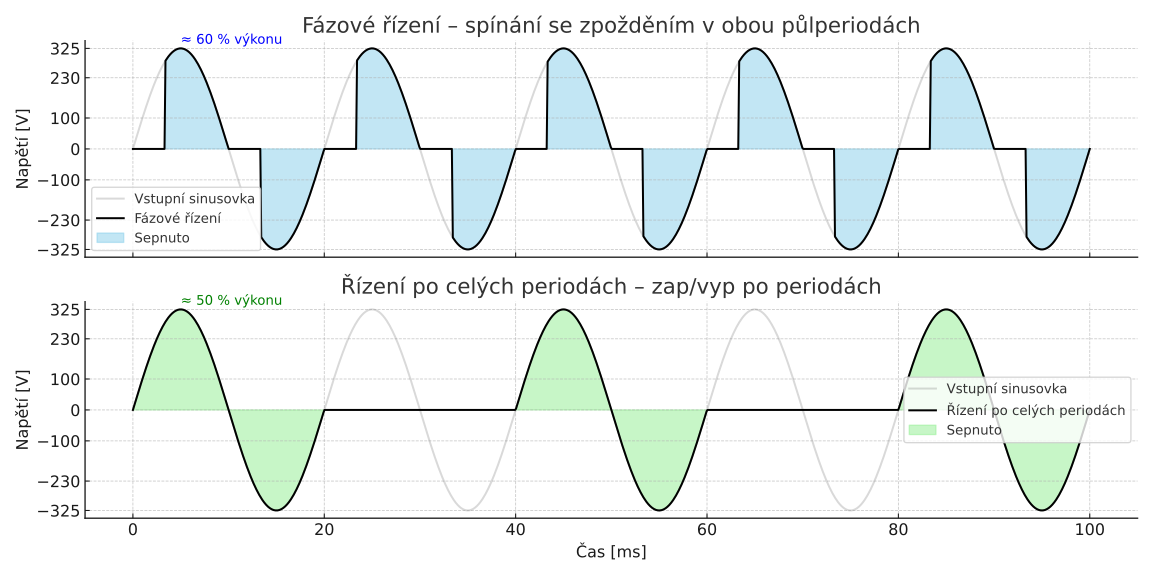
The following illustrates a comparison of both control methods using a sinusoidal voltage waveform:
- Top graph (blue) – phase based control: Power is regulated by delaying the switching in each half-cycle. The load is turned on only for part of the cycle. Approximate power: 60 %.
- Lower graph (green) – period-based control: power is regulated by the number of periods the load is on and off. Two periods on, two periods off. Approximate power: 50 %.
Recommendations
- If the goal is smooth power control and the grid is sufficiently robust (or a filter is in place), phase control can be used.
- If it is necessary to minimize EMC interference and harmonics, period-based control can be used, but be aware of flicker — especially with high-power heating devices.
- For AC resistive loads in a low-voltage network, the best approach is often a combination of period-based switching and time-spreading of multiple loads.