

Internal LTE modems for the Foxtrot 2 series, such as the CP-2007, CP-2005, CP-2080, and others, provide full support for key European bands B1, B3, B7, B8, and B20; the supported frequency bands are listed below.
The CP-2xxx is equipped with an LTE modem that has two SMA antenna connectors:
1) MAIN (Primary):
- Main communication antenna
- Used for:
- Transmission (TX)
- Reception (RX)
- The modem will not work without it
2) AUX (Diversity / Secondary):
- Receiving antenna (RX) only
- Used for:
- Diversity reception – improving connection reliability
- MIMO (2×2) for LTE – increasing data transfer speeds
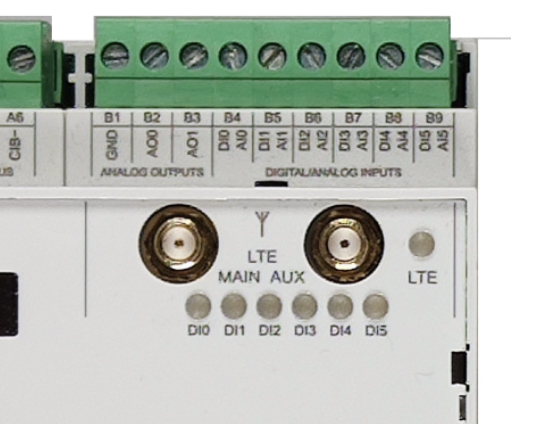
Fig. 1: Location and labeling of the LTE modem antennas on the CP-2005
Notes:
- The second antenna is not a backup; however, it increases performance and stability. For LTE, it is strongly recommended to use both.
- If only one antenna is used, the device will operate, but with reduced range and data transfer speeds.
- Antenna placement: distance between antennas min. 5–10 cm (the greater the better), ideally perpendicular polarization (90°) see Fig. 2; avoid placing them near metal surfaces or in a shielded space (metal cabinets, enclosures...)
- Suitable antennas are those designed for mobile networks (LTE / 2G/3G/4G) with an impedance of 50 Ω and an SMA connector (typically SMA(m) on the antenna) from our product range: 2JW1124-C952B (broadband LTE antenna) or the AO-AGSM-MG5S magnetic GSM antenna.
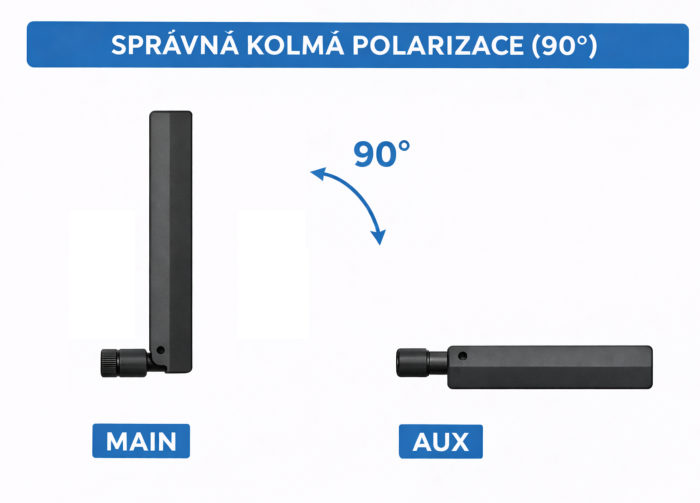
Fig. 2 Recommended orientation of both antennas ("správná kolmá polarizace (90°)" = correct perpendicular polarization (90°))
Supported frequency bands
LTE (4G)
FDD-LTE:
- B1 (2100 MHz)
- B2 (1900 MHz)
- B3 (1800 MHz)
- B4 (AWS 1700/2100 MHz)
- B5 (850 MHz)
- B7 (2600 MHz)
- B8 (900 MHz)
- B12 (700 MHz)
- B13 (700 MHz)
- B18 (800 MHz)
- B19 (800 MHz)
- B20 (800 MHz)
- B25 (1900 MHz)
- B26 (850 MHz)
- B28 (700 MHz)
TDD-LTE:
- B38 (2600 MHz)
- B39 (1900 MHz)
- B40 (2300 MHz)
- B41 (2500 MHz)
UMTS / HSPA+ (3G)
- B1 (2100 MHz)
- B2 (1900 MHz)
- B4 (AWS 1700/2100 MHz)
- B5 (850 MHz)
- B6 (800 MHz)
- B8 (900 MHz)
- B19 (800 MHz)
GSM / EDGE (2G)
- 850 MHz
- 900 MHz
- 1800 MHz
- 1900 MHz
Primary regions
- Europe (EU + UK)
- Central and Eastern Europe
- Middle East
- Africa
Secondary regions / partial compatibility
- parts of Asia (APAC) – depending on the operator’s specific LTE bands
- limited coverage in Latin America
Unsupported regions
- USA and Canada (insufficient band optimization and certification